

| At Sea., Recent News
Bergen, Norway – Havila Voyages’ Polaris will make history as the first cruise vessel in the world to complete a long-distance voyage powered entirely by battery and biogas.
The 34-port round-trip along the Norwegian coast is enabled by Bergen Engines’ advanced medium-speed gas technology, demonstrating that existing technology can deliver substantial climate benefits today.
Equipped with 2 × Bergen C26:33L6A and 2 × Bergen C26:33L9A engines, Polaris has used hybrid propulsion since its launch in 2023, combining electric power with natural gas to reduce emissions while maintaining performance. All four vessels in the Havila fleet – Capella, Castor, Polaris, and Pollux – are powered by Bergen Engines, which can operate on LNG, renewable biogas and hydrogen blends.
Havila’s Chief Executive, Bent Martini, said, “With this voyage, we aim to prove that it is entirely possible to operate the entire coastal route climate-neutrally, something we also believe should be the minimum requirement in the next tender period for the coastal route. The amount of biogas we will have on board is significant and will reduce our greenhouse gas emissions from this voyage by more than 90 per cent.”
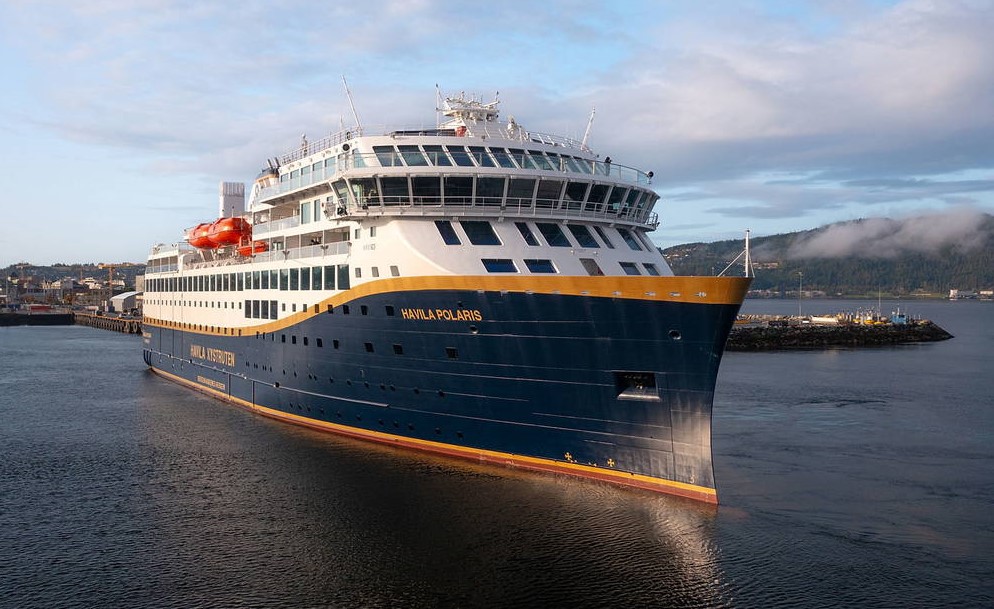 (Havila Polaris, ©Oclin)
Practical Technology, Immediate Impact
Bergen’s marine gas engines deliver low-emission performance on biogas without the need for major modifications. By switching to biogas, operators gain a renewable, low-carbon alternative to natural gas which provides cleaner energy and reliable performance for sustainable marine operations. The engines can run on biogas without any changes to operational procedures, and maintenance requirements and service life remain the same. This is especially important for vessels operating continuously along complex coastal routes.
The Future of Maritime Transport
Maritime shipping accounts for a significant share of global greenhouse gas emissions. New regulations and fuel standards are increasing pressure on operators to reduce environmental impact while maintaining performance. Bergen Engines meets this challenge with trusted, reliable engines that run efficiently on today’s low- and zero-carbon fuels and are designed to adapt seamlessly to future fuels as they become available.
The Polaris voyage represents a world-first and a milestone for climate-neutral operations. By combining proven engine technology with renewable fuel options, Bergen Engines is showing that emission-free, long-distance passenger travel is achievable and that the era of low- and zero-emission maritime operations has begun.